Key takeaways
- ✓Stream audio in real time and measure latency against the audio itself. Sending faster made results arrive "before" the speaker finished: fiction.
- ✓There are four latencies, and they disagree: Flux showed words fastest (0.21 s) but finalized them slowest (5.25 s).
- ✓Partials flicker. Showing only words two guesses agree on cut rewrites from 27% to 2%, and delayed words on screen from 0.72 s to 2.23 s.
- ✓Streaming costs accuracy: Nova-3 streaming was about 1 WER point worse than Nova-3 batch on the same clips.
- ✓A silence timer cuts off every pause longer than itself. Test endpointing with pauses of known length.
Everything so far has been batch transcription: send a file, get a transcript. Live captions and voice agents use streaming: audio is sent in small chunks as it's recorded, and the text comes back while the person is still talking. That changes what you have to measure.
| Batch | Streaming | |
|---|---|---|
| Input | The whole file | Small chunks (80 ms here) over a WebSocket |
| Output | One transcript | A running series of results |
| Context | The model hears the future of every word | It must commit before hearing what comes next |
A stream sends back three kinds of event. A partial is the current best guess, and it can change. A final won't change, so an app can act on it. A turn event says the speaker seems to be done. Systems differ in all three, so the first question of any streaming benchmark is "which event are we timing?"
Measure on the audio clock
Two rules make streaming numbers honest:
- Send audio in real time. Chunk k leaves at k × 80 ms. In the lab, sending recorded audio as fast as possible made results arrive "before" the speaker finished: Nova-3's time from speech end to final went from +0.42 s to −1.37 s, and OpenAI's live model from +3.20 s to −5.43 s. The transcripts were identical either way. Only the timing lied.
- Measure against the audio. "When was this word spoken?" is a position in the audio, not a timestamp in a log. The lab caught itself twice here: one version timed a simulated model against when it ran, not when the words were said, and another took speech boundaries from a VAD tuned for transcription, whose 0.4 s padding made Nova-3's first word look 1.00 s late instead of 0.76 s.
Four latencies, four answers
"How fast is it?" has at least four answers, and they disagree.
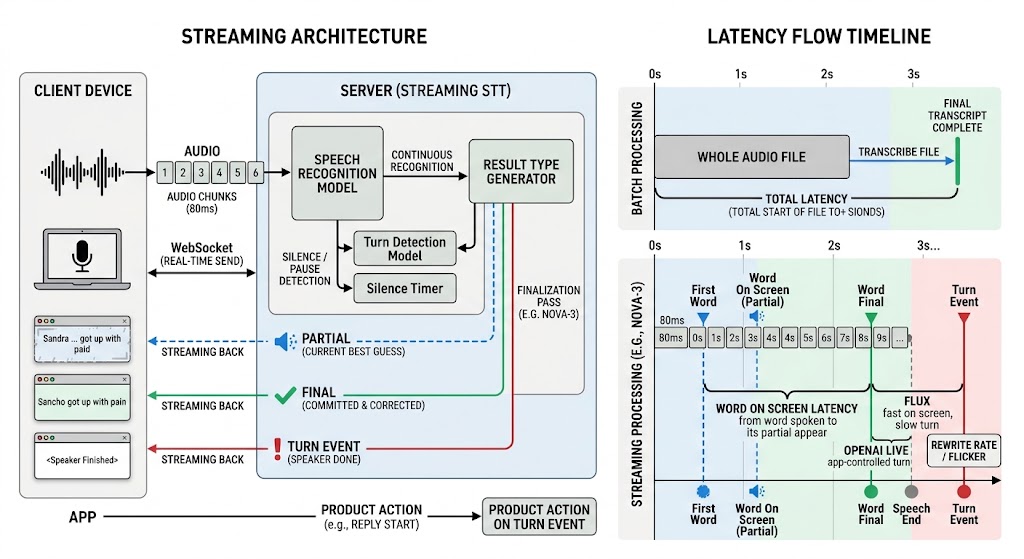 Partials, finals, and turn events — and the four clocks they produce.
A word is spoken → it first appears (as a partial). What live captions feel like.
- nova-30.57 s
- flux0.21 s
- live-openai0.92 s
- local-whisper (sim.)0.72 s
Flux shows words fastest (0.21 s) but finalizes them slowest among Deepgram's models (5.25 s), because it finalizes a whole turn at once. Which number matters depends on whether your product acts on partials, finals, or turns.
OpenAI's delay setting · 20 clips
A clean trade: three times faster on screen, twice the errors.
The ranking flips depending on the question. Flux shows words fastest, but finalizes them slowest among Deepgram's models, because it finalizes a whole turn at once. And "speech end → final" depends on who decides the speaker is done: the service (Nova-3, Flux) or the app (OpenAI's live model has no turn detection, so the app commits after silence). That's a system-design fact, not model quality.
Partials that change their mind
Partials that keep changing (flicker) look broken in captions, and an app that acts on a partial can act on a word that later disappears. This is the chapter's title in action: in the lab, Nova-3 and Flux both started with "Sandra got up with paid enough in his boat" before correcting it to "Sancho got up with pain enough in his bones".
The rewrite rate is the share of shown words that a later update changed or removed. It varied a lot: OpenAI's live model (4–5%) mostly appends; Nova-3 rewrote 12–14%, Flux 19–25%, and re-running Whisper on growing audio up to 34%.
You can buy stability with latency. Local agreement shows a word only once two consecutive guesses agree on it, and never takes it back:
Sanchogotupwithpainenoughinhisbones
Orange words just changed. Showing every guess is fast but flickers: words appear, then turn into other words. In the lab, local agreement cut rewrites from 27% to 2% and delayed words on screen from 0.72 s to 2.23 s.
One more subtlety: for Flux and OpenAI, the final just restates the last partial. Nova-3's final is a separate, more careful pass that changed 10.3% of the words. So "treat the last partial as final" is free on two systems and costly on the third.
What streaming costs in accuracy
A streaming model must commit before hearing what comes next, so it usually costs accuracy. On the same 59 clips, with speakers resampled (Chapter 4), Nova-3 streaming was +1.01 WER points worse than Nova-3 batch (95% CI +0.14 to +1.78): same model family, same clips, so that's the real price of streaming. The other comparisons were "can't tell".
Be careful what you compare. The lab's local Whisper pair seemed to stream better than batch, but the streaming side used a VAD, which removes hallucinations (Chapter 3). Name every difference between the two sides before calling a gap "the cost of streaming".
When is the speaker done?
Deciding that the speaker has finished (endpointing) is a trade-off with no free answer. A silence timer ends the turn after N ms of silence: short timers cut people off at pauses, long timers make every reply slow. An end-of-turn model (Flux) uses what's being said: "moved the appointment to…" is unfinished.
The lab tested it the right way: 12 sentences, each with a pause of known length spliced in mid-sentence. A turn that ends during the pause is a cut-off.
Turn ends after speech: p50 0.50 s · p90 0.90 s
The silence-timer rule
“I'd like to move my appointment to pause Thursday.”
- 0.4 s: waits
- 0.8 s: cut off
- 1.5 s: cut off
- 3 s: cut off
A timer cuts off every pause longer than itself, whatever is being said, and every reply waits at least 700 ms. Short timers cut people off; long timers make every reply slow. An end-of-turn model (Flux) uses what's being said instead: “move my appointment to…” is unfinished.
Real systems are fuzzier near the threshold: the timer starts when the service decides sound has stopped, so Nova-3's 300 ms timer cut off only 1 of 12 sentences at a 0.4 s pause.
Flux's model shifted the trade-off: with its default setting it ended turns faster than Nova-3's 1-second timer (0.96 s vs 1.28 s) with about the same number of cut-offs. With a stricter threshold it waited through every 1.5 s pause. One caveat the lab names: these pauses are digital silence spliced into read speech. Real pauses carry breath and room noise, and real people pause where the grammar invites it.
Reliability is part of quality
Over many streams, connections drop and turns don't finalize. Across 488 recorded streams the lab found one problem, and it's instructive: an earnings clip ended mid-sentence ("…our Chief Executive Officer and"). Flux's model heard an unfinished thought and kept waiting; the client closed after about 3.5 s of silence. The screen showed the words, and the stored transcript was empty. That's the flip side of resisting cut-offs: a client using a turn model must wait out the timeout, or force the end.
And a 12-second stall (a caller on hold) closed all 6 streams without KeepAlive messages, losing everything after the stall. With KeepAlive, all 6 were complete.
Practice: measure a stream
Implement the measurement side of streaming: the real-time send schedule, the rewrite count, local agreement, and a silence-timer endpointer. The tests use the stream from the widget above, built from the lab's real "Sandra → Sancho" example.
Quiz
1.You benchmark a streaming API by sending a recorded file as fast as the connection allows. The speech-end-to-final latency comes out at −1.37 s. What happened?
2.Your product is a voice agent. Which latency limits how soon it can start replying?
3.Flux shows words on screen in 0.21 s, but its words become final after 5.25 s. Nova-3: 0.57 s on screen, 2.52 s final. Which is better?
4.Your app treats the last partial result as if it were final, to save time. On which system is that costly?
5.You set the silence timer to 300 ms so replies feel snappy. What happens to a caller who pauses for 0.8 s mid-sentence to find their account number?
6.A stream stalls for 12 seconds (the user put the call on hold). What did the lab find?
Check your understanding
Try each question before opening its answer.
How do batch and streaming STT differ, and why does streaming usually cost accuracy?
Batch sees the full file before transcribing; streaming processes real-time chunks and must commit with less future context. Compare batch and streaming on the same clips to measure the cost.
What's the difference between partial and final results, and which should an app act on?
Partials can change; finals are committed. Captions may display partials, but actions and stored records should use finals or turn events unless the product accepts the risk of acting early.
Define first-word latency, per-word latency, and time to final. Which matters most for a voice agent?
First-word latency is speech start to first text; per-word latency is when a spoken word appears; time to final is speaker stop to final transcript. A voice agent usually cares most about end-of-turn/time-to-final before replying.
Why send audio in real time, and how do you measure when a word was spoken?
Faster-than-real-time playback can make output appear before a live speaker could have finished. Schedule chunks on the audio clock and align result timestamps to word positions in the audio.
How do you measure partial stability, and what does stability cost?
Count shown words later changed or removed and divide by words shown. Local agreement reduces rewrites, but delays words appearing on screen.
What's the endpointing trade-off, and how do you test a turn detector?
Short waits cut callers off at pauses; long waits delay replies. Insert known pauses mid-sentence, count cut-offs, and measure delay from actual speech end to detected turn end.
Which operational failures belong in a streaming quality report?
Track connection drops, turns without finals, words displayed but never finalized, duplicate or out-of-order messages, and stall/reconnect behavior. Report rates with uncertainty, especially when samples are small.
Next up: the other direction. Chapter 6 tests text-to-speech, where a voice said "negative nine quetzals" for a password.